
Zinc and Anorexia Nervosa: The Science Behind Recovery Support
Zinc is an essential trace mineral that plays a critical role in appetite regulation, immune function, and brain health. For individuals struggling with anorexia nervosa, zinc deficiency is both common and consequential, yet it often goes unrecognized in standard treatment protocols.
Research spanning more than four decades has established a clear connection between zinc status and eating disorder recovery. This guide explores the science behind zinc and anorexia nervosa, from the neurobiological mechanisms that link deficiency to appetite suppression, to practical guidance on assessment and supplementation strategies that can support recovery. Let’s dive in!
Understanding the zinc-anorexia connection
Zinc is involved in over 300 enzymatic reactions in the human body, making it essential for virtually every physiological process. It plays structural, regulatory, and catalytic roles in metabolism, immune function, DNA synthesis, and perhaps most importantly for those with eating disorders, appetite regulation.
The relationship between zinc and anorexia nervosa is bidirectional meaning zinc deficiency can contribute to the development of disordered eating patterns, while the restrictive intake and malabsorption associated with anorexia inevitably lead to zinc depletion. This creates a vicious cycle where deficiency perpetuates the very behaviors that caused it.
The striking symptom overlap
The clinical manifestations of zinc deficiency and anorexia nervosa are remarkably similar. Both conditions present with:
- Loss of appetite and early satiety
- Altered taste perception and smell
- Nausea and digestive discomfort with eating
- Depression, anxiety, and mood instability
- Difficulty concentrating and cognitive impairment
- Amenorrhea and hormonal disruptions
- Skin abnormalities and hair loss
- Increased susceptibility to stress
This overlap is not coincidental. Research suggests that many symptoms traditionally attributed to anorexia itself may actually be manifestations of underlying zinc deficiency. A landmark study by Humphries and colleagues in 1989 found that more than 50% of patients with anorexia nervosa showed biochemical evidence of zinc deficiency, with symptoms that were “almost indistinguishable” from those of zinc depletion.
How zinc affects appetite and eating behavior
To understand why zinc matters so much for eating disorder recovery, it helps to understand how this mineral influences the brain’s appetite regulation systems. Bear with us here, we’re about to get a little bit science-nerdy.
Zinc operates through multiple pathways that directly impact hunger, satiety, and food-seeking behavior. Let’s walk through some of these connections.
The Neuropeptide Y connection
Neuropeptide Y, or NPY, is the most appetite-stimulating neuropeptide in the brain. Produced in the hypothalamus, NPY normally triggers intense hunger and food-seeking behavior when energy stores are low.
In zinc deficiency, something goes wrong with this system. Research shows that zinc deficiency creates what scientists call “NPY resistance,” where NPY levels are elevated but fail to stimulate appetite normally. The brain is essentially screaming “eat” but the signal never reaches consciousness as hunger.
Zinc is required for both the synthesis and receptor function of NPY. Without adequate zinc, the hypothalamic appetite-stimulating system breaks down, making it extremely difficult to experience normal hunger cues.
Leptin and the brain-gut axis
Leptin, often called the “satiety (or fullness) hormone,” normally suppresses appetite by down regulating NPY in the hypothalamus. In zinc deficiency, leptin levels drop paradoxically low. You might expect low leptin to trigger compensatory eating, but in the context of zinc deficiency, the NPY resistance described above prevents this normal response.
Zinc also appears to influence leptin signaling directly. Research published in The Journal of Nutrition demonstrated that zinc is required for normal leptin function and that deficiency disrupts the body’s ability to regulate body fat appropriately.
NMDA receptor modulation
One of the most interesting areas of recent research involves zinc’s role as a neuro-modulator. Zinc is found in tiny sacs inside brain cells that store and release a chemical messenger glutamate which is the main chemical in the brain that turns signals “on” and helps brain cells communicate and activate each other. Zinc helps “dial down” certain brain signals that affect learning, memory, and mood. When zinc is deficient, NMDA receptors become overactive, leading to a state called “excitotoxicity” that can damage neurons and contribute to the anxiety, depression, and cognitive symptoms commonly seen in anorexia.
A comprehensive 2023 review published in CNS Drugs explored the neurobiological rationale for using zinc alongside emerging treatments like ketamine for anorexia. The authors concluded that zinc’s ability to modulate glutamatergic signaling makes it a promising adjunctive therapy for addressing the neural circuit dysfunction underlying eating disorders.
Taste and smell function
Zinc is an essential cofactor for enzymes involved in taste and smell perception. Zinc deficiency is often first detected by loss of these senses, typically occurring within 3-5 days of depletion, well before other deficiency signs appear.
For someone with anorexia, altered taste perception creates a compounding problem. Food literally does not taste as good, making eating even less appealing. Research has shown that restoring zinc status can rapidly improve taste acuity, which is often a critical first step in normalizing eating behavior.
Recognizing zinc deficiency in anorexia nervosa
Despite its prevalence, zinc deficiency often goes undiagnosed in eating disorder treatment. Part of the problem is that standard testing is unreliable, and many clinicians are not trained to recognize the subtle signs of deficiency.
Why serum zinc testing falls short
Serum zinc represents only about 0.1% of total body zinc. The body maintains serum levels within a narrow range through sophisticated homeostatic mechanisms, even when tissues are becoming depleted. This means you can have severe functional zinc deficiency while serum levels appear normal.
Additional complications in anorexia include:
- Serum zinc fluctuates up to 20% throughout the day in response to meals
- The catabolic state of starvation can artificially elevate serum zinc as tissues break down
- Inflammation and stress alter zinc distribution in the body
- Serum levels do not reflect zinc concentrations in the brain, where it matters most for appetite regulation
Better assessment approaches
Given these limitations, clinicians who specialize in zinc assessment often rely on:
Taste acuity testing: The “zinc taste test” involves tasting a zinc solution and rating its taste. Zinc-deficient individuals typically report the solution tastes like water or is tasteless, while those with adequate status describe it as metallic or unpleasant.
Clinical evaluation: A thorough assessment of symptoms, dietary intake, and risk factors can often identify deficiency even when labs appear normal.
Response to supplementation: Perhaps the most reliable test is a therapeutic trial of zinc supplementation under medical supervision. Improvement in appetite, taste, and mood within 2-4 weeks strongly suggests deficiency was present.
Risk factors specific to eating disorders
Certain factors increase the likelihood of zinc deficiency in anorexia:
- Meat avoidance: Studies show AN patients have rates of meat avoidance 6.5 times higher than healthy peers. Meat is the most bioavailable source of zinc.
- Vegetarianism: Vegetarian patients with AN have lower zinc status than non-vegetarian patients.
- High fiber intake: Phytates in fiber bind zinc and block absorption.
- Puberty: Adolescents have increased zinc requirements for growth and development.
- Chronic stress: Stress increases zinc excretion through urine.
- Excessive exercise: Depletes zinc stores through sweat and increased metabolic demands.
- Oral contraceptives: Estrogen increases zinc excretion.
Evidence for zinc supplementation in anorexia nervosa recovery
The scientific evidence supporting zinc supplementation for anorexia nervosa comes from multiple randomized controlled trials, case studies, and decades of clinical observation. While zinc is not a standalone treatment, research consistently shows it can accelerate recovery when used alongside standard care.
Key clinical trials
Birmingham et al. (1994): This double-blind, placebo-controlled trial of 35 inpatients with anorexia found that 14 mg of elemental zinc daily doubled the rate of BMI increase compared to placebo. Remarkably, only 3 patients had low serum zinc at baseline, demonstrating that normal blood levels do not rule out functional deficiency.
Katz et al. (1987): In a randomized trial of 13 adolescents with AN, those receiving 50 mg zinc daily showed greater weight gain, improved taste function, advanced sexual maturation, and reduced depression and anxiety compared to placebo.
Safai-Kutti (1990): This clinical trial of 20 young females found that 45-90 mg zinc daily led to rapid weight restoration in 85% of patients. No patients receiving zinc continued to lose weight, and 13 of 20 recovered menstrual cycles within 1-17 months.
Lask et al. (1993): A double-blind crossover study of 26 zinc-deficient children with AN found that 50 mg zinc daily plus a nutritious diet for 6 weeks resulted in rapid restoration of normal growth trajectory.
How zinc supports recovery
Research suggests zinc aids recovery through multiple mechanisms:
- Restores taste acuity: Improving taste makes eating more pleasurable and reduces aversion to food
- Normalizes appetite signals: Correcting NPY resistance and hypothalamic dysfunction allows normal hunger cues to emerge
- Improves digestion: Zinc is required for stomach acid production and digestive enzyme function
- Enhances nutrient absorption: Zinc-dependent enzymes are needed for protein digestion and absorption
- Supports mood regulation: Zinc’s role in neurotransmitter synthesis and NMDA receptor function can reduce depression and anxiety
- Promotes weight restoration: By addressing the biological barriers to eating, zinc allows psychological interventions to work more effectively
Safety considerations
While zinc is generally safe, there are important precautions:
- The tolerable upper intake level for adults is 40 mg/day long-term without medical supervision
- Doses above 50-150 mg may cause gastrointestinal upset and headaches
- Very high doses (300+ mg) can suppress immune function
- Long-term high-dose zinc can deplete copper, creating a secondary deficiency
- Zinc should always be used under professional guidance in eating disorder treatment
Food sources of zinc for recovery
While supplementation is often necessary during acute recovery, incorporating zinc-rich foods supports long-term nutritional rehabilitation. The challenge is that many zinc-rich foods are also common fear foods for those with eating disorders, requiring a gradual, supported approach to reintroduction.
Best dietary sources
Animal sources (most bioavailable):
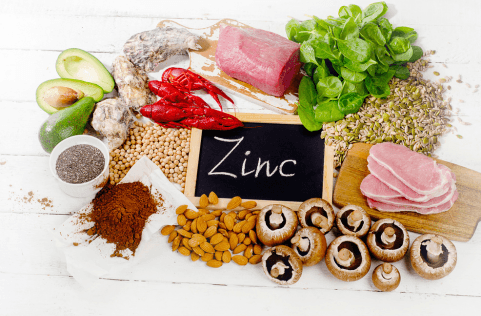
- Oysters (by far the highest concentration)
- Red meat (beef, lamb)
- Poultry (dark meat has more than white)
- Eggs
- Dairy products
Plant sources (require careful preparation):
- Pumpkin seeds and sesame seeds
- Legumes (beans, lentils, chickpeas)
- Nuts (cashews, almonds)
- Whole grains
- Fortified cereals
Maximizing absorption
Plant-based zinc is less bioavailable due to phytates, which bind zinc in the digestive tract. Strategies to improve absorption include:
- Soaking grains and legumes before cooking to reduce phytate content
- Combining plant proteins with animal proteins at meals
- Choosing leavened grain products (yeast fermentation reduces phytates)
- Avoiding excessive coffee or tea with meals (tannins inhibit absorption)

When to work with an eating disorder dietitian
Zinc assessment and management should be part of comprehensive eating disorder treatment, not a DIY approach. Working with a registered dietitian who specializes in eating disorders ensures:
Individualized assessment: A dietitian can evaluate your specific risk factors, symptoms, and dietary intake to determine if zinc deficiency is likely, even when blood tests appear normal.
Appropriate dosing: Zinc needs vary based on age, sex, degree of malnutrition, and phase of recovery. Professional guidance ensures you get enough without risking toxicity or copper depletion.
Integration with treatment: Zinc supplementation works best when coordinated with medical monitoring, therapy, and nutritional rehabilitation. A dietitian ensures all pieces work together.
Lab monitoring: Regular testing can track zinc status, copper levels, and other markers to ensure safe, effective supplementation.
At NourishRX, our team of eating disorder-specialized registered dietitians understands the complex nutritional needs of recovery. We offer personalized nutrition counseling that addresses micronutrient status alongside overall nutritional rehabilitation. Many of our sessions are fully covered by major insurance plans, including Aetna, Blue Cross Blue Shield, Harvard Pilgrim, MassGeneral Brigham, and UnitedHealthcare.
If you or a loved one is navigating anorexia recovery and want to explore whether zinc deficiency may be a factor, we offer a free care coordination call to discuss your needs and how we can help. You can also reach us at 978-927-0990 or learn more about our services.
Sources
- Birmingham CL, Gritzner S. How does zinc supplementation benefit anorexia nervosa? Eating and Weight Disorders. 2006;11(4):e109-e111. https://pubmed.ncbi.nlm.nih.gov/11930982/
- Katz R, Keen C, Litt I, et al. Zinc deficiency in anorexia nervosa. Journal of Adolescent Health Care. 1987;8:400-406. https://www.jahonline.org/article/0197-0070(87)90227-0/fulltext
- Humphries L, Vivian B, Stuart M, McClain CJ. Zinc deficiency and eating disorders. The Journal of Clinical Psychiatry. 1989;50(12):456-459.
- Safai-Kutti S. Oral zinc supplementation in anorexia nervosa. Acta Psychiatrica Scandinavica. 1990;82:14-17.
- Lask B, Fosson A, Rolfe U, Thomas S. Zinc deficiency and childhood-onset anorexia nervosa. Journal of Clinical Psychiatry. 1993;54(2):63-66.
- Shay NF, Mangian HF. Neurobiology of zinc-influenced eating behavior. The Journal of Nutrition. 2000;130:1493S-1499S. https://www.sciencedirect.com/science/article/pii/S0022316622141106
- Mitchell JS, Hermens DF, Bennett MR, et al. Ketamine and Zinc: Treatment of Anorexia Nervosa Via Dual NMDA Receptor Modulation. CNS Drugs. 2023;37:159-180. https://pmc.ncbi.nlm.nih.gov/articles/PMC9911496/
- Mahr F, Billman Miller MG, Quaill MA, Ryan SA, Nadeem T. Serum zinc levels in youth with avoidant/restrictive food intake disorder and anorexia nervosa. Nutrition and Health. 2023;29(3):365-374. https://journals.sagepub.com/doi/10.1177/02601060231191658
- Greenblatt JM, Delane DD. Zinc Supplementation in Anorexia Nervosa. Journal of Orthomolecular Medicine. 2018;33(1). https://isom.ca/article/zinc-supplementation-anorexia-nervosa/
- Psychiatry Redefined. Zinc: An Essential Element in the Fight Against Anorexia. https://www.psychiatryredefined.org/zinc-an-essential-element-in-the-fight-against-anorexia/
Frequently asked questions
How do I know if I have zinc deficiency with anorexia nervosa?
Standard blood tests for zinc are often unreliable in eating disorders. Look for symptoms like altered taste or smell, loss of appetite, hair loss, skin problems, or depression. A registered dietitian can perform a comprehensive assessment including taste testing and evaluation of risk factors. Response to a therapeutic trial of zinc under medical supervision is often the most reliable indicator.
Can zinc supplements cure anorexia nervosa?
No, zinc is not a cure for anorexia nervosa. It is an adjunctive treatment that addresses the biological component of appetite dysregulation. Recovery still requires comprehensive treatment including therapy, medical monitoring, and nutritional rehabilitation. However, research shows zinc can accelerate weight restoration and improve mood when used alongside standard care.
What is the best form of zinc for anorexia nervosa?
Chelated forms like zinc gluconate, zinc orotate, or zinc citrate are better absorbed than zinc oxide or zinc sulfate. The form used in most clinical trials was zinc gluconate. Your healthcare provider can recommend the appropriate form and dose based on your individual needs.
How long does it take to see results from zinc supplementation in anorexia nervosa?
Many patients report improvements in taste and appetite within 2-4 weeks of starting supplementation. Weight restoration typically accelerates over 6-12 weeks. Clinical trials have used supplementation periods ranging from 6 weeks to 6 months, with benefits continuing throughout treatment.
Are there risks to taking zinc supplements for anorexia nervosa?
Zinc is generally safe at recommended doses, but excessive intake can cause problems. Doses above 40 mg daily long-term should be medically supervised. High doses can cause nausea, headaches, and most importantly, copper deficiency. Always work with a healthcare provider to determine appropriate dosing and monitoring.
Can I get enough zinc from food alone during anorexia recovery?
While food sources of zinc are important for long-term recovery, research suggests that diet alone is often insufficient during acute phases of anorexia. Malabsorption, high metabolic demands during weight restoration, and food restrictions make supplementation necessary for many patients. A dietitian can help determine the right balance for your situation.

A Registered Dietitian with over 15 years of experience in the treatment of eating disorders, Ryann Hilton is a passionate advocate for helping individuals heal their relationships with food. She holds a degree in Nutrition & Dietetics from Simmons University and is a Certified Eating Disorder Specialist-Consultant (CEDS-C) through the International Association of Eating Disorders Professionals (IAEDP). She is deeply committed to using evidence-based approaches to offer practical support that reduces overwhelm and fosters healing.